
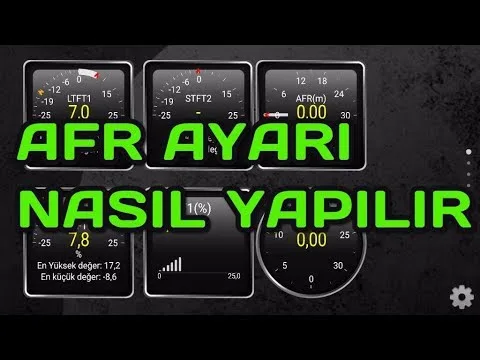
What is AFR tuning and how is it done? Does it need to be done after autogas installation? Now let's try to explain this issue..
What does AFR mean? Let's start from here first: AFR is a term consisting of the initials of the English words Air Fuel Ratio, meaning air fuel ratio in Turkish.
It is a unit that measures how many units of air enter one unit of fuel in internal combustion engines. For example, 14.7 AFR means the mixture ratio of one unit of fuel and 14.7 units of air, which is an ideal and universal value. As the value increases, that is, as the air ratio increases, our vehicle starts to run lean. As this value decreases, that is, as the air ratio decreases, our vehicle starts to run rich. Another issue we need to know is LAMDDA: the caressing sensors in our vehicles work according to the lamdda calculation, that is, the reading value of the gas coming out of the exhaust is called lambdda.
As a result of the research, it has been determined that the most ideal fuel-air mixture is 14.7. This ratio of 14.7 shows us that there is an ideal AFR mixture and ideal combustion. There are two types of reading ranges in our vehicle, one of them is Narow band, which means that the reading range of the oxygen sensor in our vehicle can make narrow band readings. The other is wideband sensor. The part of this vehicle that is not read by oxygen sensors can be measured with sensors that can make wideband readings, and this device is called an AFR device.
Vehicle oxygen sensors measure in narrow band and send signals to the ECU based on the rich mixture or lean mixture of the vehicle. The vehicle's brain is in constant activity to adjust the air fuel ratio according to these signals. Therefore, the ECU of the vehicle is constantly updated and constantly regulates the air fuel ratio of the vehicle.
However, no correction is made in the wideband section, which is the part of the vehicle that the oxygen sensor does not read. The software installed on the vehicle is alone with its own map and sends whatever needs to be sent on the map as fuel.
When our vehicles are stable at constant speed, they use the vehicle in the classical, that is, closed loop section, and make corrections by targeting the ideal AFR tuning of 14.7 in the closed loop. When the vehicle needs to accelerate, when the vehicle is given Full Throttle, the vehicle's ECU enriches the air-fuel mixture a little more while it is in open loop, that is, closed loop. There is no correction by the oxygen sensors. Because the oxygen sensors in our vehicles cannot send regulation commands with their vehicles. Because the oxygen sensors in our vehicles are Narow band, that is, narrowband sensors, there is no reading in this part. It is not.. Therefore, in open loop mode, it continues on its way by enriching the current map of the vehicle to a certain extent, and does not make instant corrections. This is where the real work of our AFR device starts and transfers information to us by reading the open loop region. We revise our tuning map according to whether the vehicle is poor or rich..
In this case, what needs to be done is to adjust the vehicle's settings on the road with an AFR device with wideband reading feature. In this way, we can see the air-fuel mixture of the vehicle at bottom throttle and we can optimize the fuel of the vehicle by taking this data into consideration. With the AFR device at bottom gas, we need to be able to obtain the air fuel ratio that it reads in petrol with LPG. The AFR value becomes richer during sudden acceleration, that is, it drops below 14.7.
We need an AFR device to see the map and air fuel ratio correctly. Since the vehicle cannot make instant corrections when it is in open loop mode, we need to consciously make the LPG adjustment map part of the vehicle at this point. This includes a wideband sensor
In other words, we need an AFR device. Because AFR values at the bottom throttle position of the vehicle are very important in terms of exhaust gas temperature and fuel performance of the vehicle.
Closed loop (open loop); These are the values that occur when we do not load Full Throttle while the vehicle is in normal motion. The lambda sensor located at the exhaust outlet of our vehicle constantly reports the air fuel mixture ratio in the vehicle's own ecu and at this point it tries to fix the lambda value at a rate, throttling or opening the vehicle. In the open loop situation, we see the vehicle's LTFT, that is, long-term fuel correction data and STFT short-term instantaneous fuel correction data, and we make corrections by looking at these values, that is, resetting the LPG installation setting. However, if If the vehicle's settings are damaged more than the specified advances, the vehicle ECU is insufficient in the fuel regulation of the vehicle and the driver is warned by turning on the vehicle warning lamp. There is a problem in the vehicle, the air fuel adjustment is unbalanced, correct this issue.
What is Edt? It means exhaust gas temperature. It shows the temperature of the exhaust gas released after the air fuel ratio is burned in the combustion chamber, and this value is very important to us. Because the exhaust gas temperature rises very high, especially in lean mixtures, and damages the exhaust valves and the catalytic converter of the vehicle. Especially when we examine it, we see that the exhaust valves melt in vehicles with burnt valves. The reason for this is the high temperature exhaust gas (EGT) that emerges as a result of the lean mixture in the vehicle.
An unregulated autogas system increases the exhaust gas temperature and therefore, as it exceeds the limits, first the exhaust valves are deformed, and then the catalytic convector, which is in contact with the exhaust, is damaged. Some active substances in the catalytic converter melt, crack or break due to this temperature. Therefore, as a result of this deformation in the catalytic convector, the catalytic convector becomes unable to function and the malfunction lamp is illuminated. burns..
Category: General, newsAfr Setting Fault Lamp in Autogas Vehicles
What is AFR tuning and how is it done? Does it need to be done after autogas installation? Now let's try to explain this issue..
What does AFR mean? Let's start from here first: AFR is a term consisting of the initials of the English words Air Fuel Ratio, meaning air fuel ratio in Turkish.
It is a unit that measures how many units of air enter one unit of fuel in internal combustion engines. For example, 14.7 AFR means the mixture ratio of one unit of fuel and 14.7 units of air, which is an ideal and universal value. As the value increases, that is, as the air ratio increases, our vehicle starts to run lean. As this value decreases, that is, as the air ratio decreases, our vehicle starts to run rich. Another issue we need to know is LAMDDA: the caressing sensors in our vehicles work according to the lamdda calculation, that is, the reading value of the gas coming out of the exhaust is called lambdda.
As a result of the research, it has been determined that the most ideal fuel-air mixture is 14.7. This ratio of 14.7 shows us that there is an ideal AFR mixture and ideal combustion. There are two types of reading ranges in our vehicle, one of them is Narow band, which means that the reading range of the oxygen sensor in our vehicle can make narrow band readings. The other is wideband sensor. The part of this vehicle that is not read by oxygen sensors can be measured with sensors that can make wideband readings, and this device is called an AFR device.
Vehicle oxygen sensors measure in narrow band and send signals to the ECU based on the rich mixture or lean mixture of the vehicle. The vehicle's brain is in constant activity to adjust the air fuel ratio according to these signals. Therefore, the ECU of the vehicle is constantly updated and constantly regulates the air fuel ratio of the vehicle.
However, no correction is made in the wideband section, which is the part of the vehicle that the oxygen sensor does not read. The software installed on the vehicle is alone with its own map and sends whatever needs to be sent on the map as fuel.
When our vehicles are stable at constant speed, they use the vehicle in the classical, that is, closed loop section, and make corrections by targeting the ideal AFR tuning of 14.7 in the closed loop. When the vehicle needs to accelerate, when the vehicle is given Full Throttle, the vehicle's ECU enriches the air-fuel mixture a little more while it is in open loop, that is, closed loop. There is no correction by the oxygen sensors. Because the oxygen sensors in our vehicles cannot send regulation commands with their vehicles. Because the oxygen sensors in our vehicles are Narow band, that is, narrowband sensors, there is no reading in this part. It is not.. Therefore, in open loop mode, it continues on its way by enriching the current map of the vehicle to a certain extent, and does not make instant corrections. This is where the real work of our AFR device starts and transfers information to us by reading the open loop region. We revise our tuning map according to whether the vehicle is poor or rich..
In this case, what needs to be done is to adjust the vehicle's settings on the road with an AFR device with wideband reading feature. In this way, we can see the air-fuel mixture of the vehicle at bottom throttle and we can optimize the fuel of the vehicle by taking this data into consideration. With the AFR device at bottom gas, we need to be able to obtain the air fuel ratio that it reads in petrol with LPG. The AFR value becomes richer during sudden acceleration, that is, it drops below 14.7.
We need an AFR device to see the map and air fuel ratio correctly. Since the vehicle cannot make instant corrections when it is in open loop mode, we need to consciously make the LPG adjustment map part of the vehicle at this point. This includes a wideband sensor
In other words, we need an AFR device. Because AFR values at the bottom throttle position of the vehicle are very important in terms of exhaust gas temperature and fuel performance of the vehicle.
Closed loop (open loop); These are the values that occur when we do not load Full Throttle while the vehicle is in normal motion. The lambda sensor located at the exhaust outlet of our vehicle constantly reports the air fuel mixture ratio in the vehicle's own ecu and at this point it tries to fix the lambda value at a rate, throttling or opening the vehicle. In the open loop situation, we see the vehicle's LTFT, that is, long-term fuel correction data and STFT short-term instantaneous fuel correction data, and we make corrections by looking at these values, that is, resetting the LPG installation setting. However, if If the vehicle's settings are damaged more than the specified advances, the vehicle ECU is insufficient in the fuel regulation of the vehicle and the driver is warned by turning on the vehicle warning lamp. There is a problem in the vehicle, the air fuel adjustment is unbalanced, correct this issue.
What is Edt? It means exhaust gas temperature. It shows the temperature of the exhaust gas released after the air fuel ratio is burned in the combustion chamber, and this value is very important to us. Because the exhaust gas temperature rises very high, especially in lean mixtures, and damages the exhaust valves and the catalytic converter of the vehicle. Especially when we examine it, we see that the exhaust valves melt in vehicles with burnt valves. The reason for this is the high temperature exhaust gas (EGT) that emerges as a result of the lean mixture in the vehicle.
An unregulated autogas system increases the exhaust gas temperature and therefore, as it exceeds the limits, first the exhaust valves are deformed, and then the catalytic convector, which is in contact with the exhaust, is damaged. Some active substances in the catalytic converter melt, crack or break due to this temperature. Therefore, as a result of this deformation in the catalytic convector, the catalytic convector becomes unable to function and the malfunction lamp is illuminated. burns..