
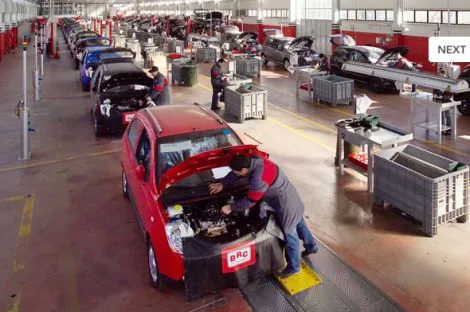
Honda CivicEco is produced ready for autogas conversion at the Honda Türkiye factory. Authorized Honda-BRC dealers who carry out this conversion safely provide 6 years and 150,000 km. offers a warranty opportunity. Honda Türkiye has taken its environmentally friendly approach to a new dimension. With the work developed by Honda on the new Civic, the CivicEco version emerged. CivicEco was introduced on Friday, September 14, 2012, in Istanbul with the participation of Honda Türkiye CEO Hideto Yamasaki. CivicEco is produced ready for autogas conversion. Authorized Honda-BRC dealers carry out this conversion with conversion kits specially developed by BRC for Honda Civic. For this conversion, Honda-BRC dealers recommend 6 years and 150,000 km. warranty opportunity is offered. The autogas option is considered an "Economic" option with the savings it provides, an "Environmentally Friendly" option because it creates less emissions compared to other fuels, and a "Safe" option because it can be installed in all kinds of vehicles by authorized Honda dealers without adversely affecting performance, thanks to new developments. In the Turkish autogas market, which grows at an average rate of 7% every year, one in every three passenger vehicles uses autogas. Honda pays attention to environmental awareness. Speaking at the introductory meeting of CivicEco, Honda Turkey CEO Hideto Yamasaki pointed out that Honda has been paying attention to environmental awareness while designing the best products since the day it was founded. Noting that they aim to reduce the CO² emissions used in their production all over the world by 30% by 2020 compared to 2000, Yamasaki said, "Environmental awareness is among our priorities in creating customer value. On the other hand, we continue our work to develop economic models for our customers. As an automobile company that prioritizes customer satisfaction, we are exploring all possibilities for our consumers to own a car under the best conditions. As an indication of both of our efforts, today, I am happy to introduce CivicEco to you." "In our previous meeting, we said that we would develop a car ready for autogas conversion for the Turkish people, here is the CivicEco, our first environmentally friendly and economical model. We aim to sell approximately 1000 units of this vehicle by the end of the year," he said.
VTEC ENGINE
All About the Engine
Variable-valve timing and electronic-lift control Variable valve timing is the engine operating system's ability to determine which valve timing will be used according to which speed and to ensure the most efficient operation at every speed. Thus, while the engine consumes less fuel at low revs, it also offers good performance at high revs. As the engine speed increases, the sliding pin camshafts transmit movement to the valves with a larger cam lobe and allow the air fuel ratio to be rearranged. This engine technology was discovered and developed by Honda and is used by it.
DOHC VTEC
The DOHC VTEC system was developed to optimize both power and torque in a high-rpm DOHC engine. For both valves, there are 3 cam profiles. The profiles on the outer sides are used at low speeds, and the profile in the middle is used at high speeds.
At low revs, the valves are opened by rockers moving in low cam profiles. These cam profiles move with short valve lift and opening time to ensure good cylinder suction and low fuel consumption at low revs. High torque and fuel savings are achieved at low and medium revs with short valve lift and opening time. As the engine speed increases, the engine's electronic control unit operates the hydraulic slide valve, which sends pressurized oil to the pins of the camshaft followers (at 5850 rpm). Pressurized oil pins move the followers designed for low speed operation to a position that locks them to the 3rd follower. Until that moment, the 3rd follower does not move any valves.
With the camshaft followers being locked together, the followers operating at low rpm are forced to work at the same rate as the followers operating at high rpm. Both the lift amount of the valves has increased and the time they remain open has been extended. More filler is taken into the cylinder and the power of the engine increases with the increasing number of revolutions. It is especially necessary to pay attention after 5500 revolutions.
SOHÇ VTEC
An engine with a single overhead camshaft has a camshaft for the cylinder bank. Intake and exhaust profiles are located on the same camshaft. In the figure below, there are 3 cam profiles in the middle part of the camshaft, these are intake cam profiles. While the outer ones of these 3 profiles are used in down periods. The profile in the middle is used at high speeds. But SOHC VTEC In engines, the timing of the exhaust valves is not changed. Exhaust valves follow the same profiles for all speed bands. The biggest difference between DOHC VTEC and SOHC VTEC engines is the difference in the timing of the exhaust valves. Besides that SOHC VTEC structures of engines. DOHC is simpler than VTEC engines
At low revs. The outer two cam profiles directly move the rockers. The cam profiles used at low speeds ensure quiet operation of the engine and low fuel consumption. At high revs: the profile designed for high revs activates the follower. But as long as the follower is not connected to any piece, it does not animate any piece. At high revs, oil pressure pushes the metal pin towards the rockers and the follower, and the 3 profiles begin to move as if they had merged into one. Rockers. They follow the profile designed for high revs. At high speeds, the lift of the intake valves increases and their open time also increases. With increasing revs, more charge is sucked into the engine and the engine's power increases.
VTEC-E
The main purpose of the VTEC-E system is to provide a very lean fuel-air mixture to increase fuel economy at low revs.
The 1.5-liter SOHC VTEC-E engine produces 92 HP of power. In 12 valve mode, the air-fuel ratio can be 20:1 and above.
Category: newsatiker brc brc prices brc autogas installation wholehearted engineering candan otogaz italian brc lavato lpg lpg conversion lpg autogas milan mimgas autogas autogas installation sequential system
Honda CivicEco is produced ready for autogas conversion at the Honda Türkiye factory. Authorized Honda-BRC dealers who carry out this conversion safely provide 6 years and 150,000 km. offers a warranty opportunity. Honda Türkiye has taken its environmentally friendly approach to a new dimension. With the work developed by Honda on the new Civic, the CivicEco version emerged. CivicEco was introduced on Friday, September 14, 2012, in Istanbul with the participation of Honda Türkiye CEO Hideto Yamasaki. CivicEco is produced ready for autogas conversion. Authorized Honda-BRC dealers carry out this conversion with conversion kits specially developed by BRC for Honda Civic. For this conversion, Honda-BRC dealers recommend 6 years and 150,000 km. warranty opportunity is offered. The autogas option is considered an "Economic" option with the savings it provides, an "Environmentally Friendly" option because it creates less emissions compared to other fuels, and a "Safe" option because it can be installed in all kinds of vehicles by authorized Honda dealers without adversely affecting performance, thanks to new developments. In the Turkish autogas market, which grows at an average rate of 7% every year, one in every three passenger vehicles uses autogas. Honda pays attention to environmental awareness. Speaking at the introductory meeting of CivicEco, Honda Turkey CEO Hideto Yamasaki pointed out that Honda has been paying attention to environmental awareness while designing the best products since the day it was founded. Noting that they aim to reduce the CO² emissions used in their production all over the world by 30% by 2020 compared to 2000, Yamasaki said, "Environmental awareness is among our priorities in creating customer value. On the other hand, we continue our work to develop economic models for our customers. As an automobile company that prioritizes customer satisfaction, we are exploring all possibilities for our consumers to own a car under the best conditions. As an indication of both of our efforts, today, I am happy to introduce CivicEco to you." "In our previous meeting, we said that we would develop a car ready for autogas conversion for the Turkish people, here is the CivicEco, our first environmentally friendly and economical model. We aim to sell approximately 1000 units of this vehicle by the end of the year," he said.
VTEC ENGINE
All About the Engine
Variable-valve timing and electronic-lift control Variable valve timing is the engine operating system's ability to determine which valve timing will be used according to which speed and to ensure the most efficient operation at every speed. Thus, while the engine consumes less fuel at low revs, it also offers good performance at high revs. As the engine speed increases, the sliding pin camshafts transmit movement to the valves with a larger cam lobe and allow the air fuel ratio to be rearranged. This engine technology was discovered and developed by Honda and is used by it.
DOHC VTEC
The DOHC VTEC system was developed to optimize both power and torque in a high-rpm DOHC engine. For both valves, there are 3 cam profiles. The profiles on the outer sides are used at low speeds, and the profile in the middle is used at high speeds.
At low revs, the valves are opened by rockers moving in low cam profiles. These cam profiles move with short valve lift and opening time to ensure good cylinder suction and low fuel consumption at low revs. High torque and fuel savings are achieved at low and medium revs with short valve lift and opening time. As the engine speed increases, the engine's electronic control unit operates the hydraulic slide valve, which sends pressurized oil to the pins of the camshaft followers (at 5850 rpm). Pressurized oil pins move the followers designed for low speed operation to a position that locks them to the 3rd follower. Until that moment, the 3rd follower does not move any valves.
With the camshaft followers being locked together, the followers operating at low rpm are forced to work at the same rate as the followers operating at high rpm. Both the lift amount of the valves has increased and the time they remain open has been extended. More filler is taken into the cylinder and the power of the engine increases with the increasing number of revolutions. It is especially necessary to pay attention after 5500 revolutions.
SOHÇ VTEC
An engine with a single overhead camshaft has a camshaft for the cylinder bank. Intake and exhaust profiles are located on the same camshaft. In the figure below, there are 3 cam profiles in the middle part of the camshaft, these are intake cam profiles. While the outer ones of these 3 profiles are used in down periods. The profile in the middle is used at high speeds. But SOHC VTEC In engines, the timing of the exhaust valves is not changed. Exhaust valves follow the same profiles for all speed bands. The biggest difference between DOHC VTEC and SOHC VTEC engines is the difference in the timing of the exhaust valves. Besides that SOHC VTEC structures of engines. DOHC is simpler than VTEC engines
At low revs. The outer two cam profiles directly move the rockers. The cam profiles used at low speeds ensure quiet operation of the engine and low fuel consumption. At high revs: the profile designed for high revs activates the follower. But as long as the follower is not connected to any piece, it does not animate any piece. At high revs, oil pressure pushes the metal pin towards the rockers and the follower, and the 3 profiles begin to move as if they had merged into one. Rockers. They follow the profile designed for high revs. At high speeds, the lift of the intake valves increases and their open time also increases. With increasing revs, more charge is sucked into the engine and the engine's power increases.
VTEC-E
The main purpose of the VTEC-E system is to provide a very lean fuel-air mixture to increase fuel economy at low revs.
The 1.5-liter SOHC VTEC-E engine produces 92 HP of power. In 12 valve mode, the air-fuel ratio can be 20:1 and above.